Free bacteriostatic water & free shipping with purchases over $300
Mitochondria are often described as the powerhouses of cells, but their role goes far beyond energy production. They communicate with the rest of the cell, respond to metabolic stress, and influence processes connected to energy balance and cellular health. One of the most interesting discoveries in this area is MOTS-c, a mitochondrial-derived peptide that has become an important subject of scientific research.
MOTS-c is a 16-amino-acid peptide encoded within the mitochondrial 12S rRNA gene. Unlike many peptides that are produced from nuclear DNA, MOTS-c originates from the mitochondrial genome. Researchers are studying its involvement in mitochondrial-nuclear communication, metabolic regulation, insulin sensitivity, exercise-related signaling, and cellular stress responses.
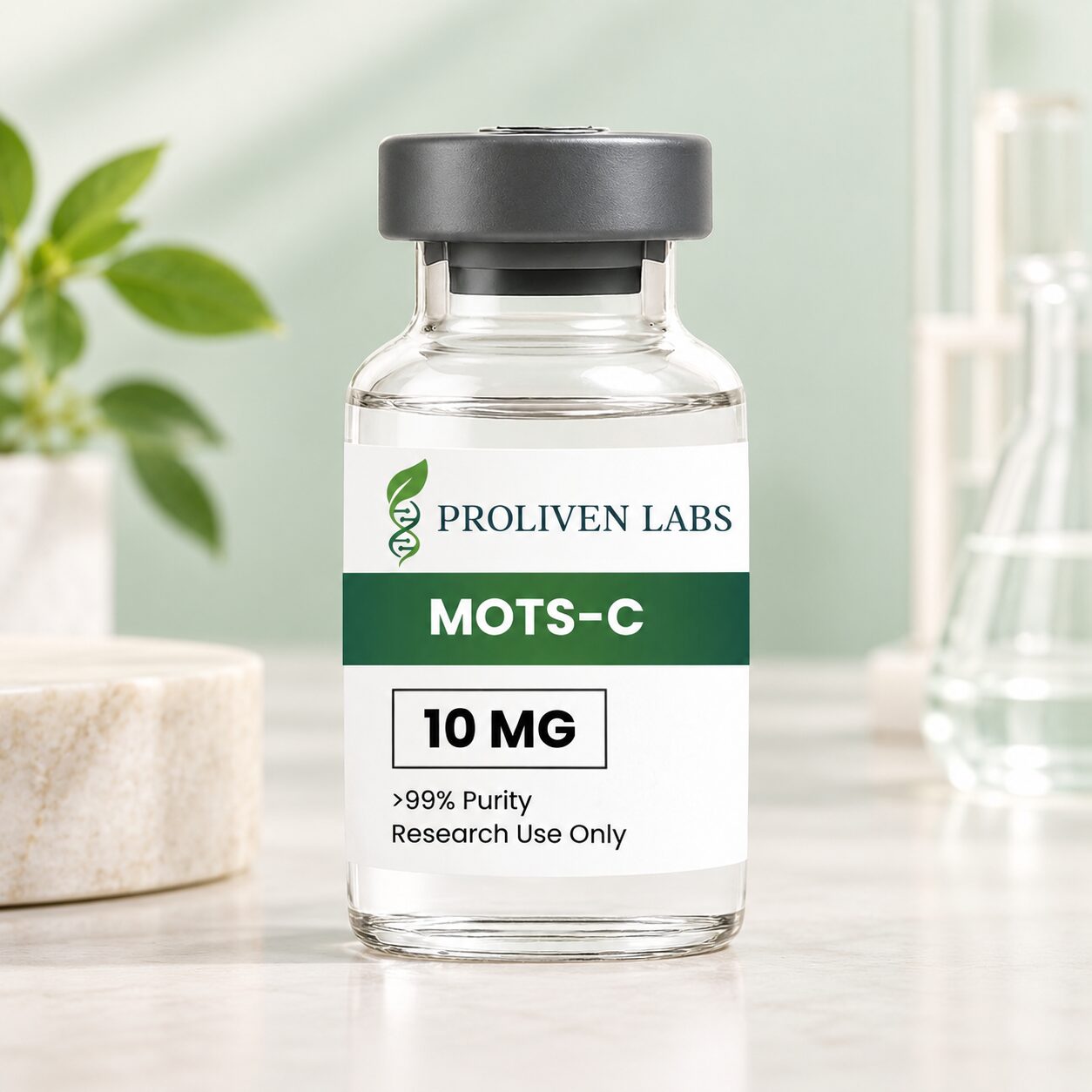
The MOTS-c 10 mg research product is supplied as a lyophilized powder and is intended exclusively for qualified laboratory researchers and in vitro experimentation. It is not approved for human or animal consumption.
What Is MOTS-c?
MOTS-c stands for Mitochondrial Open Reading Frame of the Twelve S rRNA-C. It is a mitochondrial-derived peptide designed for research into cellular metabolism and mitochondrial signaling.
According to the product specifications, MOTS-c is supplied as MOTS-c (Human) Acetate in a 10 mg vial with a reported purity of at least 98.97%, verified through third-party HPLC-MS testing. The peptide is provided as a white to off-white lyophilized powder and packaged in a sterile, vacuum-sealed amber glass vial.
Its unique origin makes MOTS-c particularly interesting for researchers investigating how mitochondria communicate with the nucleus and how cells adapt to metabolic stress.
How Does MOTS-c Work?
MOTS-c is being investigated as a bioactive mitochondrial signaling peptide. Research described for this product focuses heavily on its relationship with the AMP-activated protein kinase, or AMPK, pathway.
AMPK plays an important role in cellular energy regulation. MOTS-c research explores how activation of this pathway may influence glycolysis, beta-oxidation, mitochondrial biogenesis, and other metabolic processes.
The peptide can also move between mitochondria and the nucleus, where it may influence gene expression under metabolic stress. This mitochondrial-nuclear communication is one of the reasons MOTS-c has attracted interest in molecular biology, metabolism, and aging research.
MOTS-c and Metabolic Research
One of the primary areas of interest surrounding MOTS-c is metabolic homeostasis.
Preclinical research described in the product material examines its potential relationship with insulin sensitivity, glucose uptake, beta-oxidation, fat accumulation, and energy balance. Researchers can use MOTS-c to investigate pathways involved in metabolic syndrome, insulin resistance, obesity models, and related metabolic conditions.
This makes MOTS-c particularly relevant to laboratories studying how cells respond to changing energy demands.
It is important, however, to distinguish MOTS-c from consumer products marketed around terms such as peptides for weight loss. MOTS-c is a research peptide, and its metabolic effects should not be interpreted as evidence that it is an approved weight-loss treatment.
MOTS-c and Exercise Research
Exercise is another major area of interest in MOTS-c research.
The product information notes that MOTS-c levels can increase substantially in skeletal muscle following exercise. Research has therefore explored its relationship with endurance, mitochondrial biogenesis, and exercise-associated metabolic signaling.
This has led researchers to investigate whether mitochondrial-derived peptides could help explain some of the molecular changes that occur when cells experience physical activity.
These studies are distinct from commercial discussions about peptides for muscle growth. MOTS-c should not be presented as an approved muscle-building product. Instead, its value lies in helping researchers investigate the cellular pathways associated with energy metabolism and exercise physiology.
MOTS-c vs. Collagen Peptides
The peptide market includes many different categories, and it is important not to confuse mitochondrial-derived peptides with structural peptides such as collagen.
For example, high quality collagen peptides are generally discussed in the context of hydrolyzed collagen products, while MOTS-c belongs to a completely different scientific category. Similarly, vital proteins collagen peptides refers to a specific collagen-focused product category rather than mitochondrial signaling research.
The same distinction applies when people search for collagen peptides benefits or peptides for skin. Collagen peptides are researched and marketed in relation to structural proteins and connective tissues, whereas MOTS-c research focuses primarily on mitochondrial communication, metabolic regulation, and cellular stress responses.
Understanding this difference is important for anyone researching peptides online. The word “peptide” describes a broad class of molecules, but different peptides can have very different structures, biological roles, and research applications.
Research Into Aging and Cellular Resilience
MOTS-c has also attracted scientific interest in aging research.
The product information states that MOTS-c is expressed in tissues with high mitochondrial content, including skeletal muscle, liver, and brain, and can also be detected in plasma. Its levels have been reported to decline with age, making it an interesting subject for studies involving age-related metabolic changes.
Research applications include investigating muscle and bone homeostasis, cellular stress responses, mitochondrial function, and age-associated changes.
The goal of this research is not simply to look for a single “anti-aging” effect. Instead, scientists are examining how mitochondrial signaling may contribute to the complex biological processes associated with aging.
MOTS-c and Inflammation Research
Another area being investigated is the relationship between MOTS-c and inflammatory signaling.
The supplied product information describes research examining changes in inflammatory cytokines, including TNF-α, IL-1β, IL-6, and IL-10. These findings make MOTS-c relevant to laboratory studies exploring chronic inflammation and immune signaling.
Researchers can use appropriate experimental models to examine how mitochondrial signaling interacts with inflammatory pathways and cellular stress responses.
Why Choose MOTS-c 10 mg for Research?
For researchers working with mitochondrial and metabolic pathways, product quality and documentation are important considerations.
MOTS-c 10 mg is supplied in a lyophilized format designed to support stability during storage and transportation. The product has a reported purity of ≥98.97%, with third-party testing covering purity, endotoxins, heavy metals, and sterility. It is manufactured in ISO-certified facilities following GMP standards, with batch and lot traceability included for quality control.
Quality assurance includes HPLC-MS testing for peptide purity and identity, LAL testing for endotoxins, ICP-MS analysis for heavy metals, and microbial testing for sterility. Certificates of Analysis are available upon request.
These quality controls can be particularly valuable when researchers need reproducible materials for cell culture, biochemical assays, molecular biology experiments, and other laboratory applications.
MOTS-c as Part of Biotech Peptides Research
The growing interest in mitochondrial signaling has also contributed to the broader field of biotech peptides.
Scientists are increasingly examining peptides as signaling molecules rather than viewing them only as structural components. Mitochondrial-derived peptides such as MOTS-c provide another avenue for studying how cells communicate, regulate energy, and respond to stress.
MOTS-c can be studied alongside other mitochondrial-derived peptides, including humanin and SHLP1-6, to explore possible relationships between different mitochondrial signaling molecules. Researchers may also investigate its interaction with AMPK activators or NAD+ precursors in controlled experimental settings.
Laboratory Applications of MOTS-c
MOTS-c can be incorporated into several types of experimental research. The supplied product information identifies applications involving cell lines such as C2C12 myoblasts and HepG2 hepatocytes, as well as approved animal models.
Common research techniques may include Western blotting, qPCR, and ELISA for examining AMPK activation, cytokine levels, mitochondrial DNA expression, and related cellular responses.
Researchers should establish their own experimental concentrations and protocols according to the requirements of their specific study and applicable institutional guidelines.
Storage and Handling
Because peptide integrity can be affected by environmental conditions, proper storage is essential.
The product information recommends storing unreconstituted MOTS-c at 2–8°C in a dry, dark environment. For longer-term storage of up to 24 months, it can be kept at -20°C in a sealed container. After reconstitution, the material should be refrigerated at 2–8°C and used within 7–10 days, or appropriately aliquoted and frozen to reduce repeated freeze-thaw cycles.
Researchers should also follow appropriate aseptic handling procedures and use sterile equipment during laboratory preparation.
Research-Only Disclaimer
MOTS-c is intended exclusively for in vitro laboratory research by qualified professionals. It is not approved by the FDA or other global regulatory bodies for human or animal use, diagnostics, therapeutics, or cosmetics. The supplied product information also notes that completed human clinical trial data are unavailable and that long-term human safety remains unknown.
Researchers are responsible for following applicable institutional, ethical, and regulatory requirements when working with bioactive peptides.
Final Thoughts
MOTS-c represents an intriguing area of mitochondrial biology research. Its origin from the mitochondrial genome and its relationship with mitochondrial-nuclear communication make it particularly useful for studying energy metabolism, AMPK signaling, exercise physiology, inflammation, aging, and cellular stress.
At the same time, MOTS-c should not be confused with collagen products or consumer-focused terms such as high quality collagen peptides, vital proteins collagen peptides, collagen peptides benefits, or peptides for skin. Nor should research findings surrounding MOTS-c be interpreted as proof of approved applications involving peptides for weight loss or peptides for muscle growth.
For qualified researchers exploring mitochondrial signaling and biotech peptides, a high-purity, well-documented MOTS-c research material can provide a useful tool for controlled laboratory investigation.

 Mitochondria are often described as the powerhouses of cells, but their role goes far beyond energy production. They communicate with the rest of the cell, respond to metabolic stress, and influence processes connected to energy balance and cellular health. One of the most interesting discoveries in this area is MOTS-c, a mitochondrial-derived peptide that has become an important subject of scientific research.
MOTS-c is a 16-amino-acid peptide encoded within the mitochondrial 12S rRNA gene. Unlike many peptides that are produced from nuclear DNA, MOTS-c originates from the mitochondrial genome. Researchers are studying its involvement in mitochondrial-nuclear communication, metabolic regulation, insulin sensitivity, exercise-related signaling, and cellular stress responses.
The MOTS-c 10 mg research product is supplied as a lyophilized powder and is intended exclusively for qualified laboratory researchers and in vitro experimentation. It is not approved for human or animal consumption.
Mitochondria are often described as the powerhouses of cells, but their role goes far beyond energy production. They communicate with the rest of the cell, respond to metabolic stress, and influence processes connected to energy balance and cellular health. One of the most interesting discoveries in this area is MOTS-c, a mitochondrial-derived peptide that has become an important subject of scientific research.
MOTS-c is a 16-amino-acid peptide encoded within the mitochondrial 12S rRNA gene. Unlike many peptides that are produced from nuclear DNA, MOTS-c originates from the mitochondrial genome. Researchers are studying its involvement in mitochondrial-nuclear communication, metabolic regulation, insulin sensitivity, exercise-related signaling, and cellular stress responses.
The MOTS-c 10 mg research product is supplied as a lyophilized powder and is intended exclusively for qualified laboratory researchers and in vitro experimentation. It is not approved for human or animal consumption.