Free bacteriostatic water & free shipping with purchases over $300
Introduction
The field of metabolic research has witnessed remarkable progress in recent years, with innovative peptide compounds opening new possibilities for studying obesity, appetite regulation, and glucose metabolism. Among these emerging compounds, Cagrilintide 10mg has gained significant attention for its long-acting properties and unique mechanism of action.
Developed as a synthetic amylin analogue, Cagrilintide is designed to mimic the effects of the naturally occurring hormone amylin. Researchers are actively investigating its potential role in appetite suppression, satiety enhancement, body weight regulation, and improved metabolic function. Thanks to its extended half-life and receptor activity, Cagrilintide has become an important addition to the growing portfolio of biotech peptides used in metabolic research.
This article explores how Cagrilintide works, its research applications, key features, storage recommendations, and why it continues to attract interest among researchers studying obesity and related metabolic conditions.
Understanding Cagrilintide
Cagrilintide is a long-acting synthetic peptide that functions as a non-selective agonist of amylin receptors (AMYR) and calcitonin receptors (CTR). These receptors play an important role in regulating appetite, gastric emptying, and energy balance.
Unlike naturally occurring amylin, which is rapidly broken down in the body, Cagrilintide has been engineered to remain active for a much longer period. This extended activity allows researchers to investigate sustained biological responses with less frequent administration during experimental protocols.
Its ability to influence multiple metabolic pathways makes it an attractive candidate for preclinical and clinical research involving obesity, insulin resistance, and glucose regulation.
How Cagrilintide Works
Amylin is naturally secreted alongside insulin from pancreatic beta cells after meals. It contributes to appetite control by communicating with specific regions of the brain responsible for hunger and fullness.
Cagrilintide mimics these physiological actions by:
Activating amylin receptors involved in appetite regulation
Increasing feelings of fullness after meals
Reducing overall food intake
Delaying gastric emptying
Supporting healthier glucose metabolism
Promoting improved lipid metabolism
Its long-acting structure allows these effects to remain active for extended periods, making it particularly valuable in metabolic research studies.
Why Researchers Are Interested in Cagrilintide
Obesity remains one of the world's fastest-growing health concerns. Researchers continue exploring new methods of regulating appetite without directly targeting traditional pathways alone.
Cagrilintide provides several research advantages:
Experimental studies indicate meaningful reductions in food intake through enhanced satiety signaling.
Metabolic Support
Research suggests positive effects on glucose regulation and lipid metabolism, making it valuable for metabolic investigations.
Combination Therapy Research
Scientists continue exploring Cagrilintide alongside GLP-1 receptor agonists to better understand potential synergistic effects on weight management and glycemic control.
Key Features of Cagrilintide 10mg
Researchers appreciate several characteristics that distinguish this peptide:
≥99% Purity
Each batch undergoes extensive quality verification to ensure consistency and reliability for laboratory studies.
Lyophilized Powder
The freeze-dried formulation improves stability while extending shelf life under proper storage conditions.
Enhanced Stability
Trehalose is included to improve solubility during reconstitution while helping preserve peptide integrity.
Extended Half-Life
Compared with natural amylin, Cagrilintide remains biologically active for considerably longer, making it suitable for long-duration studies.
Research Grade Quality
Manufactured specifically for laboratory investigations involving obesity, appetite regulation, and metabolic research.
Research Areas Being Explored
Obesity Research
One of the primary research interests surrounding Cagrilintide is obesity management. Studies have demonstrated dose-dependent reductions in body weight, largely attributed to appetite suppression and lower caloric intake.
Researchers continue examining its long-term effects on body composition and energy balance.
Type 2 Diabetes Research
Cagrilintide is also being evaluated for its influence on glucose control.
Current research investigates how activation of amylin pathways may complement insulin activity and improve overall metabolic regulation.
Metabolic Disorders
Scientists are exploring how Cagrilintide affects:
Insulin sensitivity
Lipid metabolism
Energy expenditure
Appetite signaling
Body weight regulation
These investigations may contribute to a broader understanding of metabolic diseases.
Combination Peptide Research
Growing interest surrounds combining Cagrilintide with GLP-1 receptor agonists such as semaglutide or dual agonists like tirzepatide to study enhanced metabolic outcomes.
Product Specifications
Researchers working with Cagrilintide 10mg should be aware of the following specifications:
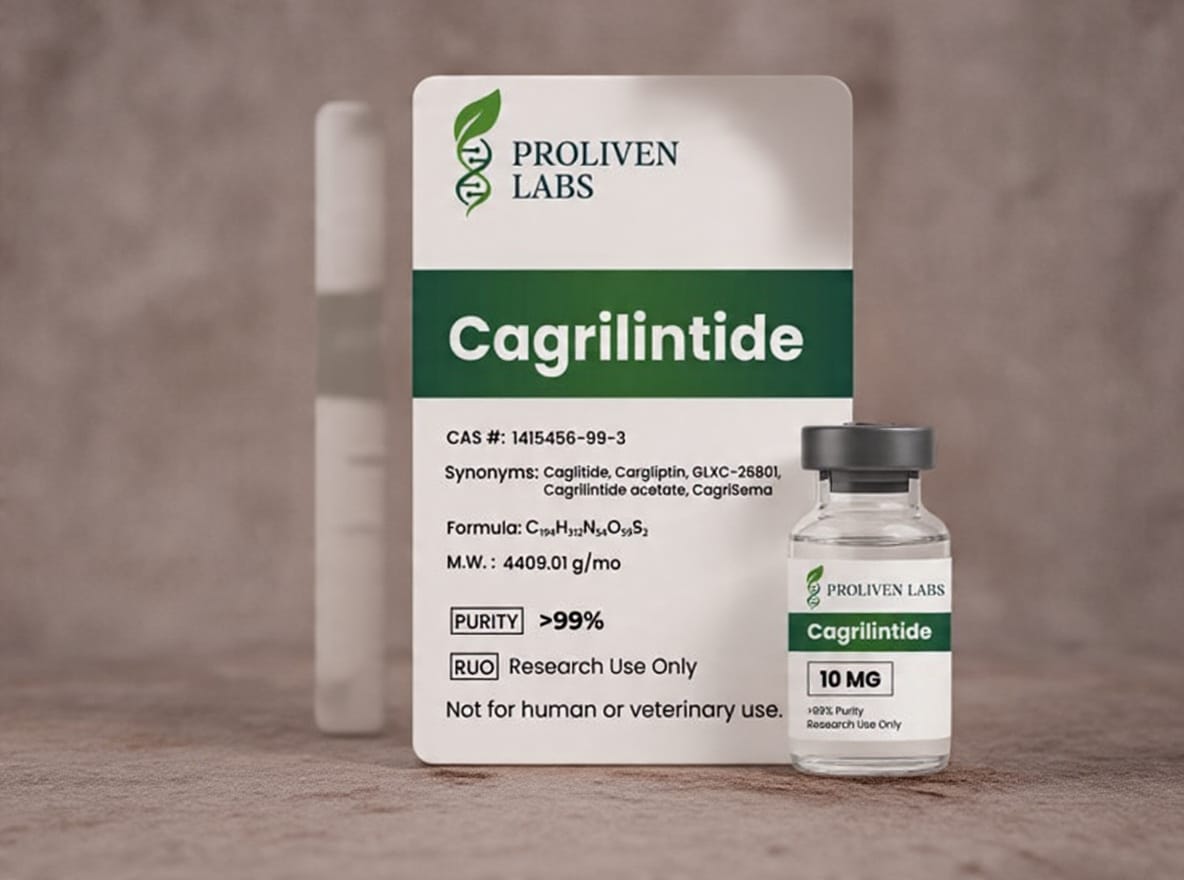
Molecular Formula: C194H312N54O59S2·xC2H4O2
Molecular Weight: 4409.01 g/mol
CAS Number: 1415456-99-3
Synonyms: AM833, AT42613
Appearance: White lyophilized powder
Quantity: 10mg per sterile vial
The peptide should always be stored according to laboratory guidelines to preserve stability and integrity.
Storage Recommendations
Proper storage is essential for maintaining peptide quality.
Recommended storage includes:
Store at −80°C for long-term preservation.
Store at −20°C for shorter-term storage.
Keep sealed to prevent moisture exposure.
Protect from direct light.
Store under nitrogen whenever possible.
Maintaining appropriate storage conditions helps preserve biological activity throughout the research period.
Reconstitution Guidelines
Before experimental use, the lyophilized powder requires reconstitution using bacteriostatic water.
Researchers should:
Use sterile laboratory equipment.
Mix gently without excessive agitation.
Avoid repeated freeze-thaw cycles.
Follow institutional laboratory protocols.
Proper handling helps reduce contamination risks and preserves peptide stability.
Cagrilintide and Other Research Peptides
Today's peptide research extends far beyond a single compound. Laboratories often investigate numerous peptide categories depending on their scientific objectives.
For example, researchers interested in connective tissue may study high quality collagen peptides or compare formulations such as vital proteins collagen peptides to better understand structural protein supplementation.
Other scientific investigations focus on peptides for muscle growth, peptides for skin, and various compounds associated with tissue regeneration. Meanwhile, metabolic researchers continue exploring peptides for weight loss, including innovative molecules like Cagrilintide that target appetite regulation rather than collagen production.
The expanding field of biotech peptides continues to provide valuable tools for understanding complex biological systems across multiple areas of research.
Why High Purity Matters
Reliable research depends heavily on product quality.
High-purity peptides help researchers:
Improve experimental consistency
Reduce unwanted contaminants
Enhance reproducibility
Produce more reliable data
Support accurate biological evaluation
Using well-characterized research materials contributes to stronger scientific outcomes.
Research Use Only
Cagrilintide 10mg is supplied exclusively for laboratory research.
It is not approved for human consumption, medical treatment, or therapeutic use.
All handling, storage, reconstitution, and experimental procedures should follow institutional laboratory safety protocols using appropriate protective equipment.
Conclusion
Cagrilintide represents an exciting advancement in metabolic peptide research. Its long-acting amylin receptor activity, appetite-regulating properties, and potential influence on glucose and lipid metabolism have made it an increasingly valuable research compound.
As scientific interest in peptides for weight loss continues to grow, Cagrilintide stands out among modern biotech peptides because of its extended activity and promising research applications. Whether investigated independently or alongside other metabolic compounds, it continues to contribute valuable insights into obesity, metabolic health, and appetite regulation.
Although researchers may also investigate high quality collagen peptides, vital proteins collagen peptides, collagen peptides benefits, peptides for muscle growth, and peptides for skin, Cagrilintide occupies a distinct place in peptide science by focusing specifically on metabolic pathways rather than collagen supplementation.
Frequently Asked Questions
Is Cagrilintide a collagen peptide?
No. Cagrilintide is an amylin analogue designed for metabolic research. It is not a collagen peptide.
What research is Cagrilintide commonly used for?
Researchers primarily investigate Cagrilintide in studies involving appetite regulation, obesity, glucose metabolism, metabolic disorders, and peptides for weight loss.
How should Cagrilintide be stored?
For optimal stability, it should be stored at −80°C for long-term preservation or −20°C for shorter-term storage while protecting it from moisture and light.
Can Cagrilintide be combined with other research peptides?
Current research is exploring combinations with GLP-1 receptor agonists to better understand potential synergistic metabolic effects.
Why is peptide purity important?
High-purity biotech peptides help improve consistency, reproducibility, and reliability throughout laboratory research.
Is Cagrilintide intended for human use?
No. Cagrilintide is supplied strictly for research purposes and is not approved for human consumption.
Meta Title: Cagrilintide 10mg | Research Peptide for Weight Management
Meta Description: Learn how Cagrilintide 10mg supports metabolic research, appetite regulation, and peptides for weight loss with high-purity biotech peptides for laboratory use.
Suggested Image Alt Text: Cagrilintide 10mg research peptide vial for metabolic and obesity laboratory studies.

 Introduction