
Introduction
Peptide science continues to provide researchers with valuable tools for investigating cellular signaling, endocrine pathways, metabolism, aging, and tissue biology. Among the compounds studied in growth hormone research, Ipamorelin is particularly notable for its selective interaction with the growth hormone secretagogue receptor.
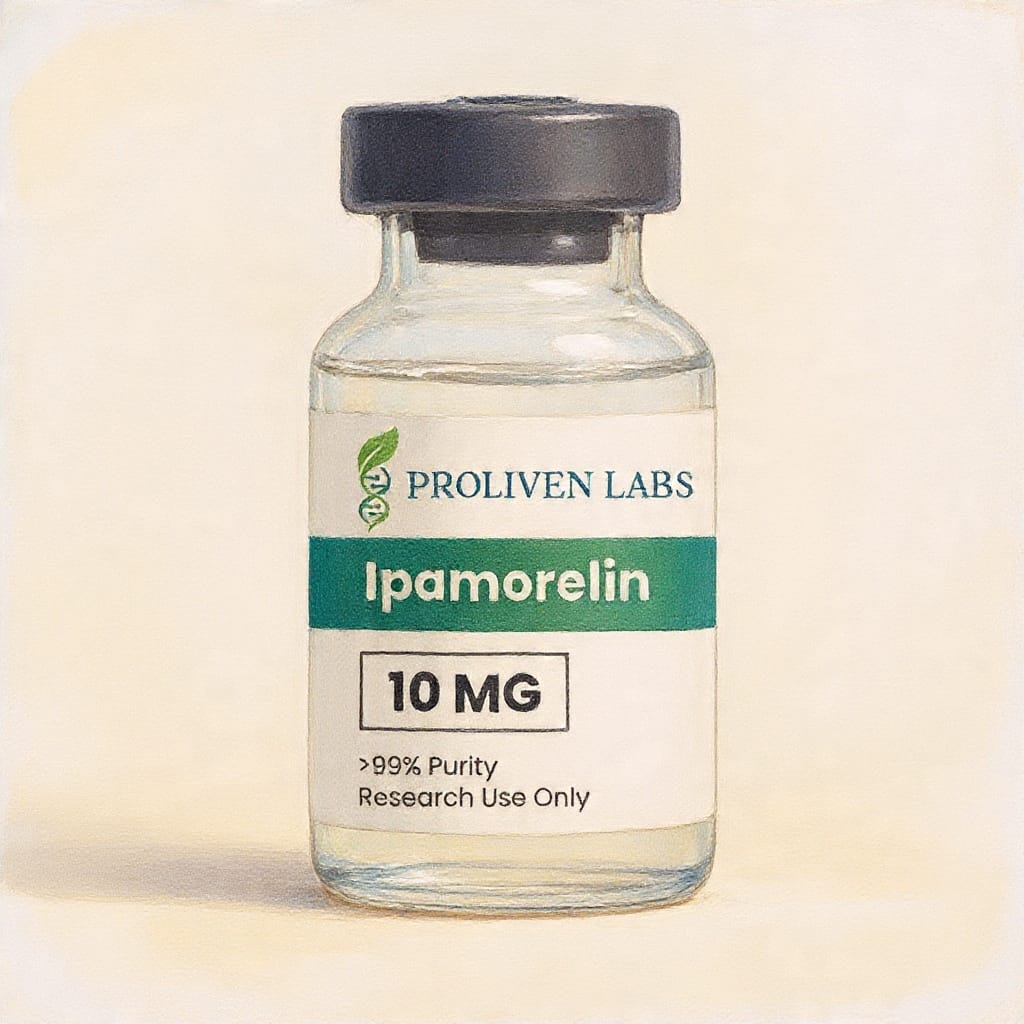
Ipamorelin 10 mg is a synthetic pentapeptide supplied as a highly purified lyophilized powder for laboratory and preclinical research. With a purity of ≥99%, verified through HPLC and mass spectrometry, it is designed to support controlled studies examining growth hormone signaling and related physiological processes.
What Is Ipamorelin?
Ipamorelin is a synthetic pentapeptide with the sequence Aib-His-D-2-Nal-D-Phe-Lys-NH2. It functions as a selective growth hormone secretagogue by interacting with the ghrelin/growth hormone secretagogue receptor (GHS-R1a).
Unlike some earlier growth hormone releasing peptides, Ipamorelin has been investigated for its relatively selective effect on growth hormone release, with limited influence on several other hormones in experimental models.
This selectivity makes it a useful research compound for scientists studying the relationship between growth hormone and broader physiological processes.
How Does Ipamorelin Work?
Ipamorelin acts as a ghrelin receptor agonist, stimulating GHS-R1a receptors involved in growth hormone secretion. Research has examined its ability to promote pulsatile growth hormone release while maintaining a comparatively selective endocrine profile.
Experimental studies have reported minimal effects on hormones such as ACTH, cortisol, prolactin, FSH, LH, and TSH compared with less selective growth hormone secretagogues.
This characteristic has made Ipamorelin an interesting compound for researchers investigating growth hormone dynamics and endocrine signaling.
Key Research Applications
Growth Hormone Research
One of the primary applications of Ipamorelin is the study of growth hormone secretion. Researchers can use the compound to investigate how GH signaling influences different biological processes and how growth hormone secretagogues interact with GHS-R1a receptors.
Muscle and Tissue Research
Growth hormone and related signaling pathways are involved in numerous processes associated with tissue maintenance. Ipamorelin is therefore studied in experimental models examining muscle biology, recovery mechanisms, and cellular growth.
Metabolic Research
Researchers are also interested in the relationship between growth hormone, metabolism, and energy regulation. Ipamorelin provides a tool for studying GH-mediated pathways that may influence metabolic processes.
Aging Research
Changes in growth hormone secretion are associated with aging. Because Ipamorelin can stimulate GH release in experimental settings, researchers use it to investigate age-related changes in endocrine signaling and cellular physiology.
Bone Health Studies
Growth hormone and related pathways play roles in bone development and remodeling. Ipamorelin may therefore be included in preclinical research examining the relationship between GH signaling and skeletal biology.
Gastrointestinal Research
Ipamorelin has also been investigated in research involving gastrointestinal motility. Its interaction with the ghrelin receptor makes it relevant to studies exploring the connection between ghrelin signaling and gastrointestinal function.
Ipamorelin 10 mg Specifications
Product: Ipamorelin 10 mg
Form: Lyophilized powder
Purity: ≥99%
Molecular Formula: C38H49N9O5
Molecular Weight: 711.868 g/mol
CAS Number: 170851-70-4
Peptide Sequence: Aib-His-D-2-Nal-D-Phe-Lys-NH2
Appearance: White to off-white powder
Solubility: Soluble in sterile or bacteriostatic water
Packaging: Sterile, vacuum-sealed glass vial
Third-party HPLC and mass spectrometry testing can help verify peptide identity, purity, and batch consistency.
Why Purity Matters in Peptide Research
Reliable experimental results depend heavily on the quality and consistency of research compounds. Ipamorelin with ≥99% purity provides researchers with a standardized material for controlled laboratory investigations.
Reputable research suppliers should provide appropriate quality documentation, including Certificates of Analysis (CoA), batch information, and testing results. Manufacturing under cGMP-compliant conditions can also provide additional quality and traceability standards.
Stability and Storage
Ipamorelin is supplied in lyophilized form to improve stability during storage. According to the product specifications, the unopened material should be kept refrigerated at 2–8°C in a dry, dark environment and protected from excessive heat, moisture, and light.
For laboratory handling and reconstitution, researchers should follow their established institutional protocols and the supplier's validated instructions. Sterile equipment and appropriate laboratory practices are important for minimizing contamination.
Research-Only Use
Ipamorelin 10 mg is intended strictly for laboratory and controlled preclinical research. It is not approved for human consumption, medical treatment, dietary use, or veterinary applications.
Researchers should handle the compound using appropriate personal protective equipment and follow applicable institutional, regulatory, and laboratory safety requirements.
Conclusion
Ipamorelin 10 mg is a high-purity research peptide that provides scientists with a valuable tool for investigating growth hormone secretion and GHS-R1a receptor signaling. Its selective pharmacological profile makes it particularly relevant to studies involving endocrine function, metabolism, muscle biology, aging, bone health, and gastrointestinal research.