
Description
Product Overview
ARA-290, also known as cibinetide or pyroglutamate helix B surface peptide (pHBSP), is a synthetic peptide designed to mimic part of the exposed three-dimensional surface of erythropoietin (EPO). It is a structural mimetic rather than a simple contiguous fragment of EPO’s amino acid sequence.
ARA-290 was developed to investigate tissue-protective activity separately from EPO’s stimulation of red blood cell production. Foundational research described nonerythropoietic activity alongside tissue-protective effects in experimental models. These findings describe the compound’s research background; they do not establish the safety or effectiveness of this research product for medical use.
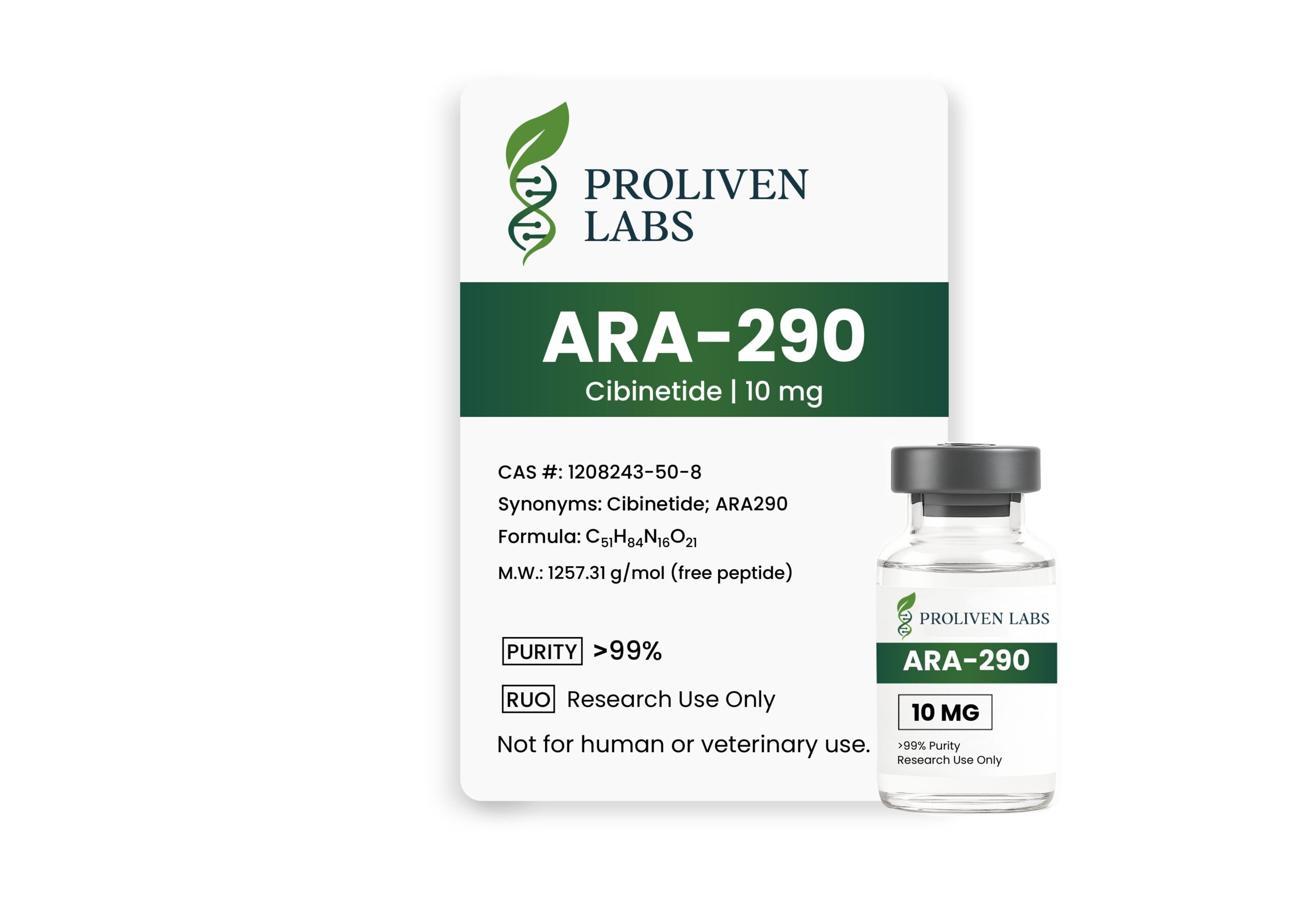
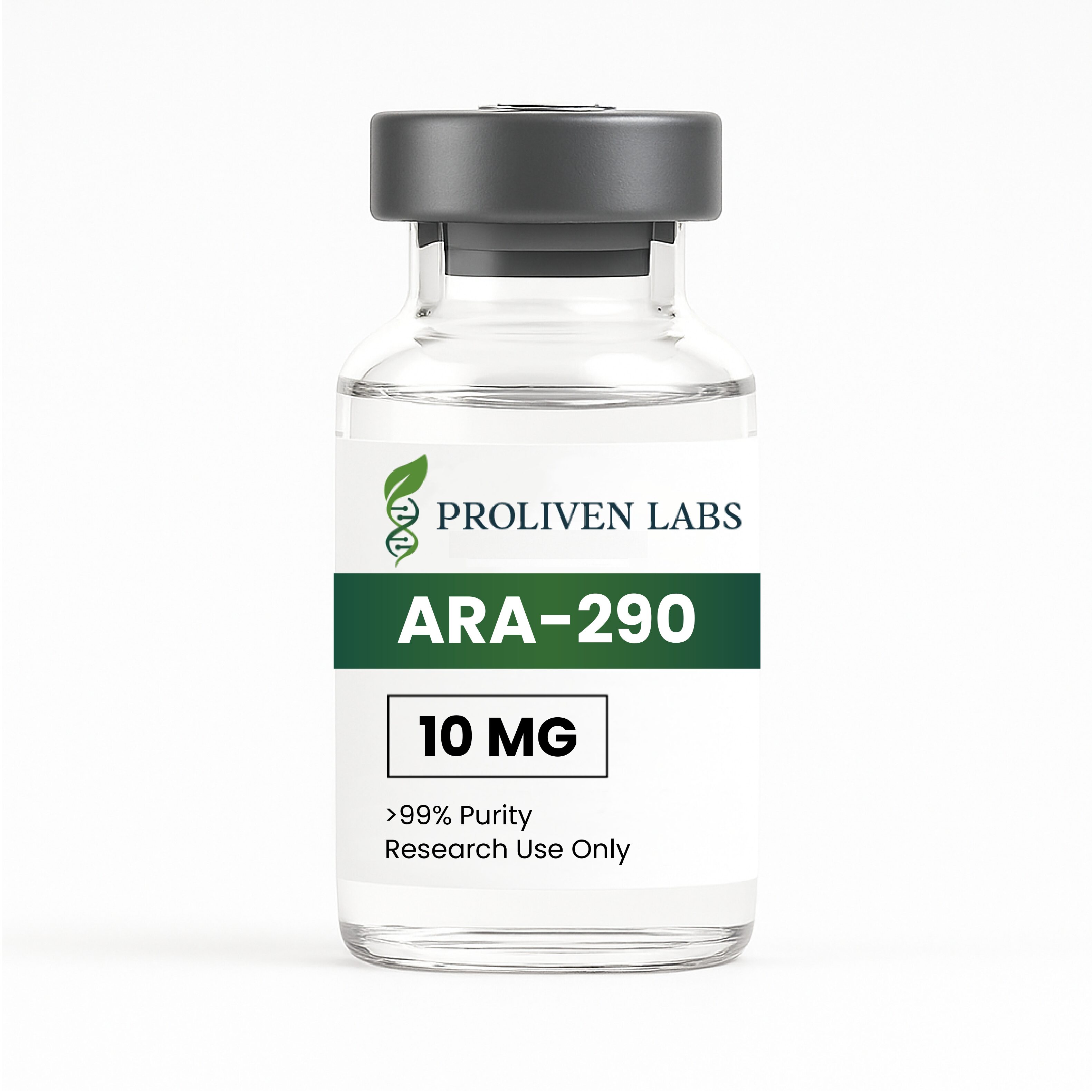
Proliven Labs ARA-290 is offered in a 10mg vial presentation for laboratory research.
For research use only (RUO). Not for human or veterinary use.
Research Applications
Tissue-Protective Signaling
Foundational studies investigated whether peptides modeled on EPO’s exposed surface could retain tissue-protective activity without stimulating erythropoiesis. This work provides a basis for studying cellular injury responses and the separation of erythropoietic and tissue-protective signaling.
Inflammation and Experimental Tissue Injury
Preclinical investigations have examined pHBSP in models of hemorrhagic shock and renal ischemia–reperfusion injury. These studies evaluated organ injury, inflammatory responses, and associated signaling pathways. Results are specific to the experimental models and conditions studied.
Small Nerve Fiber Biology
Published clinical investigations of investigational ARA-290/cibinetide have assessed neuropathic symptoms and small nerve fiber measurements. These publications provide scientific background; the investigational preparations used in those studies should not be assumed equivalent to a commercially supplied research reagent.
| Published investigation | Research findings and limitations |
|---|---|
| 2012 randomized pilot study: sarcoidosis-associated small fiber neuropathy | Twenty-two participants were enrolled. The study reported improvement in a small fiber neuropathy symptom questionnaire, while pain and fatigue measures improved similarly in both groups. Its small size and short duration limit interpretation. |
| 2015 phase 2 study: type 2 diabetes with neuropathic symptoms | Researchers reported changes in selected metabolic and neuropathic symptom measures. Corneal nerve fiber findings included a subgroup with reduced baseline nerve fiber density. These exploratory findings require further validation. |
| 2017 phase 2b study: sarcoidosis-associated small nerve fiber loss | A 64-participant trial reported a significant placebo-corrected increase in corneal nerve fiber area in one treatment group. Pain improved across groups; the reported placebo-corrected pain comparison did not reach statistical significance. |
These studies support continued investigation, not claims of proven nerve regeneration, reliable pain relief, or established clinical benefit.
For research use only (RUO). Not for human or veterinary use.
Mechanism of Action
ARA-290 is described in the research literature as acting through the innate repair receptor (IRR), a receptor complex involving the erythropoietin receptor (EPOR) and the beta-common receptor subunit (CD131).
This proposed tissue-protective signaling system is distinguished from the classical EPOR homodimer associated with red blood cell production. The research rationale is to investigate protective signaling without reproducing EPO’s erythropoietic activity. This distinction does not establish that ARA-290 is free of adverse effects.
In a rat hemorrhagic-shock model, pHBSP administration was associated with changes in Akt, endothelial nitric oxide synthase, and inflammatory signaling, including NF-κB. These are model-specific mechanistic observations rather than a universally established pathway response in every tissue or assay.
For research use only (RUO). Not for human or veterinary use.
Reconstitution & Handling Instructions
Prepare research solutions according to the supplied material’s verified salt form, documented solubility, and the requirements of the intended assay.
- Consult the product specification, COA, and safety data sheet before handling.
- Select a solvent and buffer compatible with both the peptide and the experimental system.
- Record the solvent, concentration, pH where relevant, preparation date, and storage conditions.
- Evaluate solution stability under the actual experimental conditions.
- Use suitable aliquots when supported by the laboratory’s validated procedure to limit repeated freeze–thaw exposure.
No universal solvent volume, refrigerated solution lifetime, or shelf life is specified here because these require product-specific supporting data.
Laboratory solution preparation does not establish sterility or suitability for administration.
For research use only (RUO). Not for human or veterinary use.
Product Specifications
| Specification | Details |
|---|---|
| Product name | ARA-290 |
| Established name | Cibinetide |
| Common synonyms | ARA 290; ARA290; pHBSP; PHBSP; pyroglutamate helix B surface peptide |
| CAS registry number | 1208243-50-8 |
| Compound class | Synthetic peptide |
| Peptide length | 11 amino acid residues |
| Sequence | pGlu–Glu–Gln–Leu–Glu–Arg–Ala–Leu–Asn–Ser–Ser–OH |
| N-terminal modification | Pyroglutamate |
| C-terminus | Free carboxylic acid |
| Molecular formula | C₅₁H₈₄N₁₆O₂₁ — free peptide |
| Molecular weight | Approximately 1,257.3 g/mol — free peptide |
| Nominal quantity | 10mg per vial |
| Container | 3mL Glass Vial |
| Physical form and appearance | Lyophylized Powder |
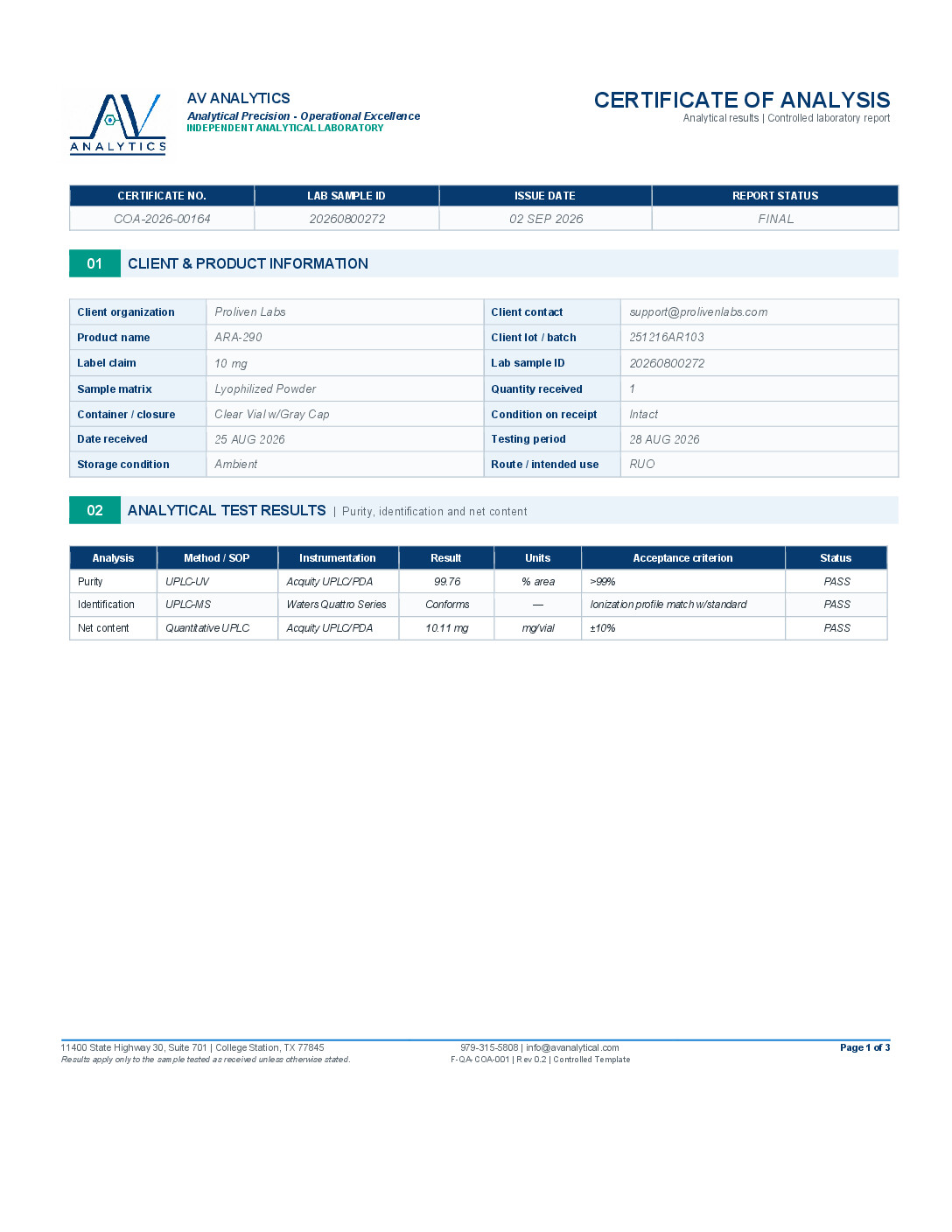
| Purity | >99% |
| Peptide content | 10mg |
| Identity verification | Batch/lot numbers on CoAs and vials |
| Storage and stability | Refer to the validated product specification and batch documentation |
| Intended use | Laboratory research only |
Chemical identifiers, sequence, formula, and molecular weight correspond to the PubChem record for cibinetide. “pGlu” denotes the N-terminal pyroglutamate residue.
Molecular-weight clarification: The value above excludes counterions and associated water. Acetate and trifluoroacetate forms have separate chemical records; their formula weights should not be substituted for the free-peptide value without identifying the supplied form.
Quality Control and Assurance
Assess each lot using its corresponding analytical documentation.
Relevant quality attributes include:
- Identity: Analytical evidence consistent with the expected peptide.
- Purity: A stated chromatographic result with the method identified.
- Content: A quantitative peptide assay, where available.
- Traceability: A lot number connecting the vial to its documentation.
- Additional testing: Counterion, water, residual solvent, endotoxin, or bioburden results where required for the research application.
Chromatographic purity is not the same as peptide mass content. An HPLC area percentage alone does not establish that a vial contains 10mg of peptide, nor does it establish sterility or endotoxin status.
For research use only (RUO). Not for human or veterinary use.
Safety and Handling Precautions
ARA-290 10mg is designated for in vitro research by trained professionals in controlled laboratory settings. Key safety considerations include:
- Intended Use: Not for human or animal consumption, medical, cosmetic, or diagnostic purposes. In the US, UK, and Australia, ARA-290 is not FDA-approved or TGA-approved and is restricted to research.
- Handling: Use sterile gloves, syringes, and equipment to prevent contamination. Follow biosafety level 1 (BSL-1) protocols unless otherwise specified.
- Storage Precautions: Protect from light, heat, and moisture. Avoid shaking reconstituted solutions, as mechanical stress may denature the peptide.
- Disposal: Dispose of unused or contaminated product in accordance with local biohazard regulations.
- Legal Compliance: Researchers must comply with all applicable regulations in their jurisdiction, including DEA, FDA, or equivalent guidelines for controlled substances or research chemicals.
Disclaimer
ARA-290 10mg is sold exclusively for scientific research and development purposes. It is not intended for human or animal use, nor as a drug, supplement, or cosmetic. Improper use may result in adverse effects, and researchers assume full responsibility for compliance with local laws. For detailed safety information, refer to the supplier-provided Safety Data Sheet (SDS). xAI and its affiliates are not liable for misuse of this product.



Reviews
There are no reviews yet.